

Left-Turn Collisions and Disputed Right-of-Way in Virginia
A left-turn collision can happen in seconds. One driver begins crossing an intersection while another vehicle approaches from the opposite direction, and each person may leave the crash with a very different account of what happened. The turning driver may insist there was enough time to cross. The approaching driver may say the turn left no room to stop.
Those competing accounts matter because liability in a Virginia left-turn accident is not always resolved simply by identifying which vehicle was turning. Traffic signals, speed, distance, visibility, witness accounts, and the movement of both vehicles can change the right-of-way analysis. After a serious collision in Northern Virginia, an experienced Leesburg auto accident attorney can investigate how the crash occurred and address attempts to shift responsibility onto the injured driver.
When a Left-Turning Driver Must Yield
Virginia law places an important duty on motorists making left turns. Under Virginia Code § 46.2-825, a driver intending to turn left at an intersection, or into an alley, private road, or driveway, must yield to an oncoming vehicle that is close enough to constitute a hazard. A separate left-turn signal changes that rule: a driver proceeding under the authorized left-turn signal has the right-of-way over other vehicles approaching the intersection.
The phrase “close enough to constitute a hazard” makes the circumstances immediately before the collision important. Distance alone does not tell the entire story. Investigators may need to determine how quickly the approaching vehicle was traveling, where the turning vehicle was positioned, and how much time each driver had to react.
A driver who misjudges an approaching vehicle and turns across its path may be responsible for the resulting collision. A disputed claim, however, can require more than an assumption that the turning vehicle automatically caused the crash.
Speed Can Change the Right-of-Way Dispute
The approaching driver’s speed can become one of the most important issues in a left-turn case. A motorist preparing to turn might reasonably believe there is enough distance to complete the maneuver based on the apparent speed of oncoming traffic. An approaching vehicle traveling substantially faster than expected can close that distance much sooner.
Virginia Code § 46.2-823 specifically provides that a driver traveling at an unlawful speed forfeits any right-of-way the driver otherwise would have under Virginia’s right-of-way statutes. That provision can become significant when an insurer starts with the position that the approaching vehicle necessarily had priority because the other driver was making a left turn.
Evidence of speed may come from vehicle damage, roadway marks, electronic vehicle data, surveillance footage, dash-camera video, or witnesses who observed the vehicles before impact. The location and severity of the damage can also help establish how far the turning vehicle had progressed before the collision occurred.
Traffic Signals Can Decide Who Had the Right-of-Way
Some of the most difficult left-turn claims begin with a basic disagreement over the traffic light. The turning driver says there was a green arrow. The approaching driver says the light was green in the opposite direction. Without independent evidence, the claim can quickly become one driver’s account against the other’s.
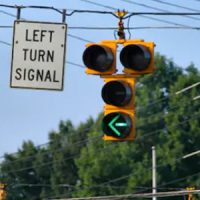
A protected left-turn arrow is especially important because § 46.2-825 gives the turning driver the right-of-way when the intersection has a separate left-turn signal and the turn is being made as directed by that signal. An approaching motorist who enters against the controlling signal can completely alter the liability analysis.
Nearby businesses, homes, traffic cameras, and private vehicles may have recorded the intersection. Witnesses who were stopped in adjacent lanes may also remember which traffic movement had the signal. That information can disappear quickly as footage is overwritten and witnesses become more difficult to locate.
A Turn Signal Does Not Make the Turn Safe
Using a turn signal communicates an intended maneuver, but it does not give a driver permission to enter the path of another vehicle. Virginia Code § 46.2-848 requires a driver intending to turn to first make sure the movement can be completed safely and to provide the required signal when another vehicle could be affected.
That distinction can matter after a crash. A turning driver may argue that the signal was activated well before reaching the intersection. The signal may show that the turn was announced, but the remaining question is whether the driver had enough time and space to make it safely.
The same evidence can expose problems with an insurer’s reconstruction of the accident. Vehicle positions, impact points, debris, and photographs of the intersection can show that a turn was already substantially completed or that the approaching driver had more opportunity to react than initially claimed.
Why Contributory Negligence Raises the Stakes
Fault disputes carry particularly serious consequences in Virginia because the state continues to apply contributory negligence. Virginia’s civil model jury instructions outline how any proximate negligence by a plaintiff can serve as a complete bar to recovering damages, even if the defendant was also negligent. The parties’ negligence is not simply compared and divided by percentage.
That makes allegations against the injured driver far more consequential than they would be under a comparative-negligence system. An insurance company defending a left-turn claim may argue that the approaching driver was speeding, failed to keep a proper lookout, accelerated into the intersection, or otherwise contributed to the crash.
Those allegations deserve careful scrutiny. A statement made immediately after the collision, an incomplete police report, or an inaccurate assumption about who had the right-of-way can become central once contributory negligence is raised. Establishing the sequence of events before positions harden can make a substantial difference in a contested Virginia auto accident claim.
Physical Evidence Can Resolve Conflicting Accounts
Drivers involved in the same collision often remember it differently, especially when the impact was sudden and violent. Objective evidence can provide a clearer picture of what occurred.
The point of impact may show how far a vehicle had progressed through the intersection. Damage along the side of a turning vehicle can tell a different story from damage concentrated near its front bumper. Skid marks, gouges, debris fields, and final resting positions may also help reconstruct the timing and direction of the collision.
Electronic data has become increasingly important as well. Depending on the vehicles involved, recorded information may help establish speed, braking, throttle position, or other activity shortly before impact. When combined with photographs, video footage, and witness accounts, that evidence can challenge an oversimplified claim that the left-turning driver was automatically at fault.
Speak with Our Leesburg Auto Accident Attorneys
If you were injured in a left-turn collision, a disagreement over the right-of-way can quickly become a dispute over your ability to recover compensation. Preserving evidence early can be especially important when the other driver or an insurance company claims that your speed, reaction, or movement through the intersection contributed to the accident.
Simms Showers LLP represents injured clients facing serious auto accident claims in Virginia. Contact Simms Showers LLP to speak with an experienced Leesburg auto accident attorney about the collision, disputed liability, and the evidence available to establish how the crash occurred. We offer a free phone consultation for personal injury cases.
This memorandum is provided for general information purposes only and is not a substitute for legal advice particular to your situation. No recipients of this memo should act or refrain from acting solely on the basis of this memorandum without seeking professional legal counsel. Simms Showers LLP expressly disclaims all liability relating to actions taken or not taken based solely on the content of this memorandum.
Sources:
- Virginia General Assembly, Code of Virginia § 46.2-825, “Left turn traffic to yield right-of-way”
law.lis.virginia.gov/vacode/title46.2/chapter8/section46.2-825/ - Virginia General Assembly, Code of Virginia § 46.2-823, “Unlawful speed forfeits right-of-way”
law.lis.virginia.gov/vacode/title46.2/chapter8/section46.2-823/ - Virginia General Assembly, Code of Virginia § 46.2-848, “Signals required on backing, stopping, or turning”
law.lis.virginia.gov/vacode/title46.2/chapter8/section46.2-848/ - Supreme Court of Virginia, Virginia Model Jury Instructions – Civil, Instruction No. 6.050, “Contributory Negligence: Parties’ Negligence Not Compared”
vacourts.gov/static/courts/circuit/resources/model_jury_instructions_civil.pdf